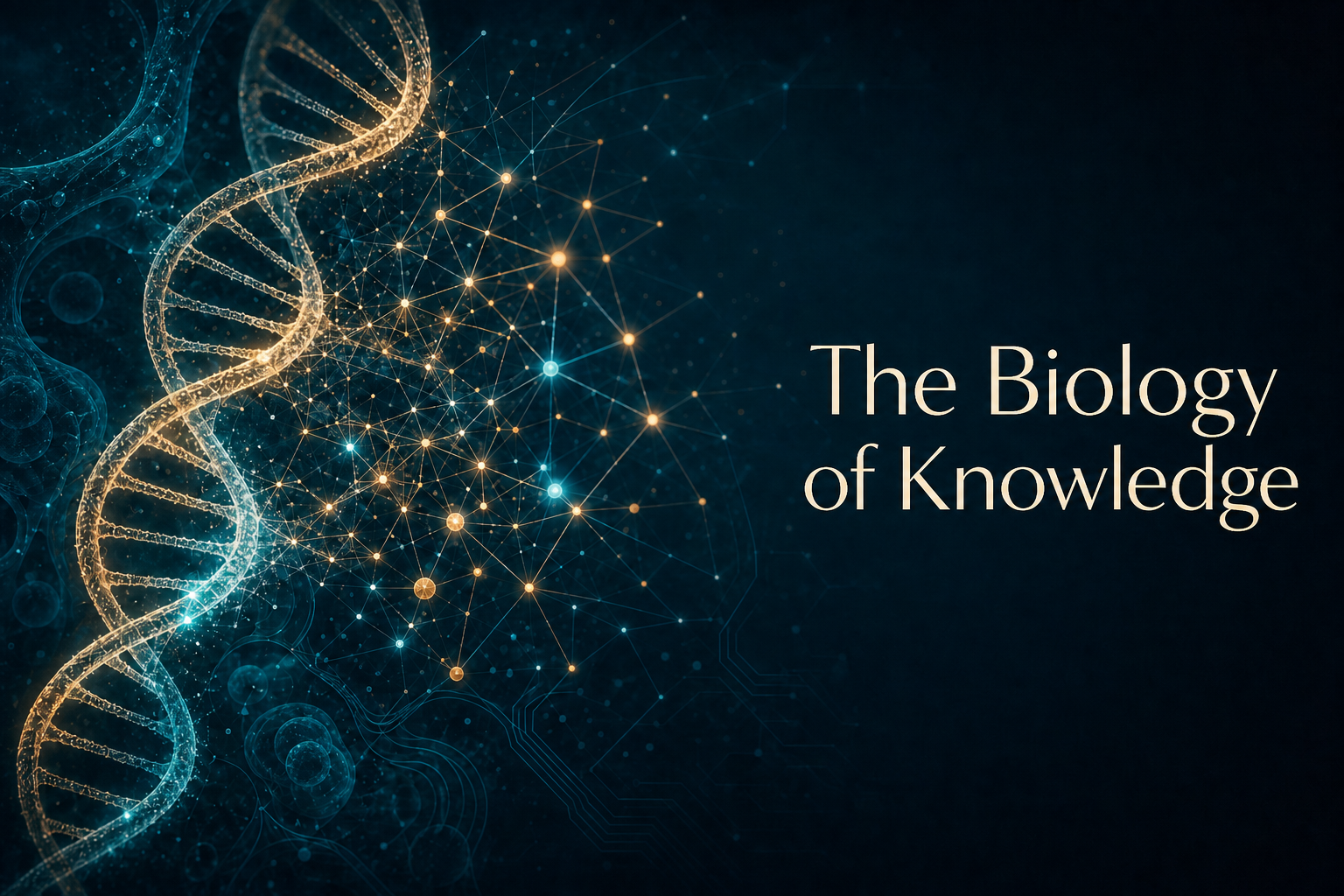
“One cannot beat four billion years of
evolution managing knowledge”
We keep treating enterprise data like inventory in a warehouse: catalogue it, lock it, audit it, and hope it stays where we put it. Then we bolt an AI on top and act surprised when it produces confident nonsense at scale.
Life never had that luxury. For roughly four billion years, biology has solved the exact problem we now struggle with, keeping enormous amounts of information accurate, reusable, defended and inheritable inside a noisy, hostile, energy-constrained world, and it did so without a central database, without downtime, and at a fraction of the energy cost of any system we have ever built.
So maybe the smartest move in enterprise data, information, knowledge and decision management is not to invent something new. It is to apply bio-mimicking and get inspired from the incumbent that has been winning since the first cell.
Here are molecular biology mechanisms translated into principles for enterprise digital asset management, enabling intelligent decision-making and, ultimately, business survival in a world where predatory behavior is on the rise.
1. The Data – The Genome: your DNA is your competitive substrate
DNA is the durable substrate of life: a stable, compact, faithfully copied store of constraint from which an organism is built and rebuilt. It is written with a tiny four-letter alphabet, yet it encodes all of biology. The power is not in the size of the alphabet, it is in combinatorics under strict rules.
Your data is exactly this. It is your digital genome: the canonical store of what makes your organization unique. Some of it is expressed and useful right now; much of it sits silent until the right context activates it.
The mechanics translate with almost embarrassing precision:
- A nucleotide is tripartite made of phosphate, sugar, and nitrogenous base. So is the atomic unit of a knowledge graph: a triple of subject · predicate · object. Identity and structure form the backbone; meaning rides on top.
- DNA has two bond types. The covalent backbone is strong and permanent, it defines identity. The hydrogen bonds between paired bases are weak and reversible, they “unzip” so the strand can be read and copied. In your graph, the identity edges (the IRIs, the type hierarchy) must be stable and governed, while the associative edges (the relationships you traverse when you query and reason) are meant to be opened and re-formed constantly.
- Complementarity means bases pair only in valid ways. In a governed knowledge graph, domain/range constraints and validation shapes decide which connections are legal. This is not a limitation, it is the source of two superpowers life relies on: faithful copying and automatic error detection. A wrong pairing physically distorts the helix; an invalid statement trips a constraint violation.
Biology spends far more energy keeping DNA correct than making it, through proofreading, mismatch repair, excision of damaged spans, and redundancy. Enterprise data quality should work the same way: validation at write, single-writer canonical sources, provenance on every fact, reconciliation against the authoritative version. Quality is engineered through constraint plus redundancy plus repair, never through hoping the data is clean.
The lesson: stop protecting data as dead archive. Protect it as a genome, identified, traceable, self-checking, and ready for expression.
2. The Information – The Transcriptome: data expressed in context
A cell does not “use its genome” in the abstract. It expresses what is needed, when it is needed, in response to signals. DNA is transcribed into mRNA: a portable, single-stranded, context-specific copy of a gene. The full set of those transcripts, what the cell is actually reading right now, is the transcriptome.
Information (data + context metadata) is your digital transcriptome: data expressed under context. And context, in biological terms, influence epigenetics phenomena, the layer of marks that decides which genes are read without ever changing the underlying sequence. In the enterprise, that epigenetic layer is metadata: provenance, access rights, priority, trust, framing, recency, purpose.
Transcription has four properties, and each carries a precise management rule:
- It is selective. Only some genes are read at a time; the context decides which. The same canonical knowledge yields a different transcript for a regulator, an engineer, or a partner, without touching the source.
- It is a distinct molecule. mRNA uses the Uracyl base instead of Thymine base (used in DNA), it is deliberately marked as not the original. Every report, dashboard and query result must carry the same tag: this is an expression, not the source of truth.
- It is spliceable. One gene contains coding and non-coding ssegements and can yield several different transcripts for different purposes. One governed concept can be shaped into different audience-specific and use-case-specific views.
- It is disposable. mRNA is translated, then degraded. Most information should have a half-life: it circulates, drives a decision, and expires. It does not write back to the canon directly.
This is the discipline most data architectures miss. The same fact, “Study entered Phase 2 on 1 March”, is expressed with full audit trail to a regulator, stripped to a date on an operations dashboard, silenced entirely to an unauthorized party, and marked historical after the study closes. One truth, many expressions, zero rewrites of the canon. That is how you become context-sensitive without fragmenting the truth.
3. The Knowledge – The Proteome: information folded into things that work
mRNA is translated into proteins, the working machines of the cell. A protein is only useful once it folds into the right three-dimensional shape; a misfolded protein is useless at best and toxic at worst. The full set of an organism’s proteins, its functional capability at a given moment, is the proteome.
Knowledge is your proteome. It is information folded into reusable, functional form: models, rules, decision logic, policies, procedures, explanations, that is fit-for-purpose to answer/solve a specific question/answer. Raw information becomes knowledge only when it is folded into something that can act, and only when that shape is validated.
The biochemistry translates in key knowledge management principles:
- Folding is validation. In the cell, chaperones fold proteins and quality-control machinery rejects the misfolds. In the enterprise, validation shapes (think SHACL-style constraints) decide whether an expressed piece of information has become functional knowledge or a defect.
- Misfolding is falsehood. A false belief is a misfolded knowledge-protein. Some are simply broken; the dangerous ones are prion-like, self-replicating belief-shapes that convert healthy reasoning into copies of themselves and propagate through your models at machine speed.
- Proteostasis is governance. Cells continuously monitor folding fidelity and mount a stress response when misfolded proteins accumulate. Knowledge systems need the same standing function: red-teaming, contradiction detection, provenance checks, model audits.
- Modularity is reuse. Biological networks reuse a small set of recurring motifs that perform defined functions. Knowledge assets should likewise be modular, composable, and understandable in combination, not artisanal one-offs.
And crucially, knowledge is ephemeral. A protein is judged by function; knowledge is judged by whether it still helps you act, learn, adapt, make the optimal decision. When it no longer fits reality, it must undergo precision recycling mechanism (the Ubiquitin–Proteasome system or Autophagy–Lysosome pathway in the cell), graceful, programmed retirement. A knowledge system that cannot kill its own obsolete certainties does not accumulate wisdom, it accumulates dogma.
Knowledge is therefore not “what we have stored”. It is what currently increases our capacity to act well.
4. The Decision – The Metabolome: knowledge acting on the world
Proteins do not sit still. They catalyse metabolism, the flow that turns inputs signals from context into action, energy, waste and memory. The metabolome is the complete, measurable set of metabolites in the cell: the real-time readout of what the organism is actually doing.
Decision intelligence is your metabolome. A decision is knowledge acting on the world, the working action, the measurable outcome where governed data, information and knowledge finally create value. It is the readout that tells you whether the whole system is healthy.
Two biological principles matter most here:
- Metabolism is a flow, not a stock. Cells ingest, digest, circulate, store briefly, burn for energy, and excrete the rest. Hoarding is pathology: fat, plaque, tumour. Enterprises that only govern storage are governing one-sixth of the metabolism, and they end up with a data swamp. The value and the health live in digest, circulate, burn and excrete. Govern the flow.
- Every decision closes a loop. A living cell acts, senses the consequence, and adjusts, homeostasis through feedback. A decision is never optimal; it is a compromise that mitigates risk. So no decision should disappear into action without a return path to memory. The measured consequence updates the knowledge, refolds the models, and tunes the next expression. Without that loop, decision-making becomes ritual, not intelligence.
The mature operating cycle is simple to state and hard to live: sense, express in context, fold into knowledge, act, measure the consequence, repair, remember or forget. The metabolome is how you feel whether that cycle is producing value or quietly poisoning you.
5. Enzymes and AI Agents: the specialized catalysts
Enzymes are the proteins that make the cell’s chemistry possible. Left alone, biochemical reactions are too slow to sustain life; enzymes catalyse them, making transformations fast, specific and reliable. Critically, there is no universal enzyme. Each is fit for one specialized task, and each is switched on and off by signal transduction, the cascade that carries an environmental signal from a receptor to a response.
AI agents are your enzymes. They accelerate the value chain by carrying out governed transformations across data, information and knowledge, but the biology is a warning as much as a promise:
- There is no one-size-fits-all. Just as the cell runs thousands of distinct enzymes, an intelligent system needs specialized agents, one to transcribe canonical knowledge into an insight, one to shape it for an audience, one to translate between vocabularies, one to fold a draft answer against a validation shape, one to actually trigger an action in the world. A single generic model asked to do everything is a cell with one enzyme: mostly dead.
- Signal transduction is the point. An agent is only as good as its ability to accurately capture environmental signals and adapt its behaviour. Sensing the context correctly is the hard part; the transformation is the easy part.
- Catalysts must be governed. An enzyme acts within a controlled compartment, on a specific substrate, with quality control on its output. An agent must operate under the same discipline: governed access, confidence scoring, provenance on every output, and validation before its result is allowed to act. An ungoverned agent is not a catalyst, it is a toxin that produces plausible waste at scale.
Agents accelerate life. They do not replace the genome, the context, or the governance, they run inside them.
6. Membranes and Boundaries: where meaning is protected
A cell without a membrane dies. But life did not build one membrane, it built two, and conflating them is the mistake most enterprise architectures make.
- The cell membrane faces outward, toward the world. It is fast, situational and porous by design. Its job is to decide what is relevant right now, to sense reality, parse it into meaning, and select what may cross. This is your context boundary. And here is the uncomfortable truth: you cannot buy it. You can buy generic data (the DNA) and you can buy AI (enzymes), but the membrane, your owned, connected model of your world, woven from shared identifiers and open semantics, is the one thing you must build yourself. A membrane made of a vendor’s proprietary formats is just a smaller cage. Lose it, and you are no longer a distinct organism; you are a component inside someone else’s.
- The nuclear membrane faces inward, toward the DNA, the data. It is slow, conservative and tightly gated. Its job is to decide what is true and worth remembering. This is your canon boundary, the governance gate around canonical knowledge. It controls who may read the canon, protects it from being rewritten by the noisy outside world, and allows only validated consequence to pass back and update it, through one narrow, curated door.
The discipline that falls out of two membranes is the whole game: context is allowed to be fast and plural; data is required to be slow and singular. The outer membrane keeps you adaptive; the inner membrane keeps you coherent. A cell needs both, or it either ossifies or dissolves.
Between them sits the transcription and epigenetic layer, the metadata that lets the same canonical truth express itself differently for every context, without a single rewrite. That combination, your membrane plus how it expresses your knowledge, is precisely the part no competitor can purchase off a shelf. It is your moat.
Digital transformation in a predatory world
Zoom out, and the reason this matters becomes stark.
The business environment is not calm. It is fast-changing, resource-constrained and increasingly predatory. AI has lowered the cost of aggression: misinformation propagates like a virus, confident falsehoods spread like prions, competitors move at machine speed, and the boundary between signal and manipulation blurs. In an environment like that, survival is not guaranteed by size. It is guaranteed by the ability to sense, adapt and act faster than the threats, exactly the problem life has been solving under predation, scarcity and constant change for four billion years.
This reframes digital transformation entirely. The goal is not a tidier warehouse with a better catalogue and a chatbot on top. The goal is to grow a living organism:
- A genome it protects, one canonical source of meaning, identified and self-checking, that survives every reorganization and turnover.
- A transcriptome it expresses in context, information shaped for the moment, marked as expression, allowed to expire.
- A proteome it folds and validates, knowledge that works, is tested by consequence, and is retired when it stops fitting reality.
- A metabolome it can feel, decisions governed as a flow, every one closing a feedback loop, so the organization senses what it is doing to itself before the damage shows up in the numbers.
- Enzymes it deploys with discipline, specialized AI agents that catalyse governed transformations, never ungoverned ones.
- Membranes it holds, an outer boundary for adaptivity and an inner boundary for coherence, plus an immune system that recognizes falsehood and a metabolism that forgets, on purpose and gracefully.
An organization built this way does not merely store more; it adapts responsibly. It hoards less and metabolizes more. It holds its purpose firmly and its models lightly. It can learn without losing integrity, change without losing identity, and act without forgetting consequence. In a predatory market, those are not nice-to-haves, they are the definition of a survivor.
Human beings have always advanced by learning from nature; biomimicry remains one of our most constructive sources of invention. We are unlikely to out-design four billion years of biological research and development in knowledge management, adaptation, and decision intelligence. The smarter course is to study the operating model life has already perfected and rebuild its principles for the enterprise so that organizations can transform digitally, make better decisions, and survive in fast-changing, increasingly hostile environments.
One cannot beat four billion years of evolution managing knowledge. So let us rebuild it, deliberately, for the organizations that intend to survive the next four.